Remove manual handoffs
Replace exports, email approvals and repeated data entry with controlled flows between the systems your teams already use.
We connect ERP, CRM, WMS, payments, mobile apps, commerce and legacy software. Data reaches the right place, failures are visible, and teams stop repairing broken handoffs by hand.
Keep the systems that already work. Replace fragile connections with an integration layer your business can trust.
Reply within 24h · initial estimate within 48h · fixed price after DDT
Business channels
Integration layer
Systems of record
Queue, retry and alert path
Every critical event has an owner and a recovery rule.
100+
integrations delivered
120+
digital projects
Fixed price
after DDT
Your code
documented and owned
The cost hides between systems
A missing order, outdated price or duplicated customer record becomes manual work, delayed service and risk. The real problem is rarely one API. It is unclear data ownership and failure handling across the whole process.
Replace exports, email approvals and repeated data entry with controlled flows between the systems your teams already use.
Define a source of truth for customers, products, prices, inventory and orders before adding more automation.
Use queues, retries, idempotency, alerts and audit trails so one unavailable system does not silently corrupt the process.
What we connect
We start from the operational outcome and then choose the smallest reliable architecture that can support it.
Orders, invoices, contract pricing, stock, warehouse movements and accounting data with clear ownership rules.
Web, mobile, POS, partner portals and marketplaces connected to one consistent product and customer model.
Payment status, refunds, courier labels, pickup schedules, tracking and exception handling across providers.
Adapters, secure APIs and staged modernization when a business-critical system cannot simply be replaced.
Production proof
The product brings pickup schedules, payments and BDO-related processes into one mobile experience. It reduced manual customer service work while connecting the app to systems already running the business.
5000+
downloads in month one
14
delivery sprints
A long-term product partnership, not a one-off API handover
Read the EMKA case study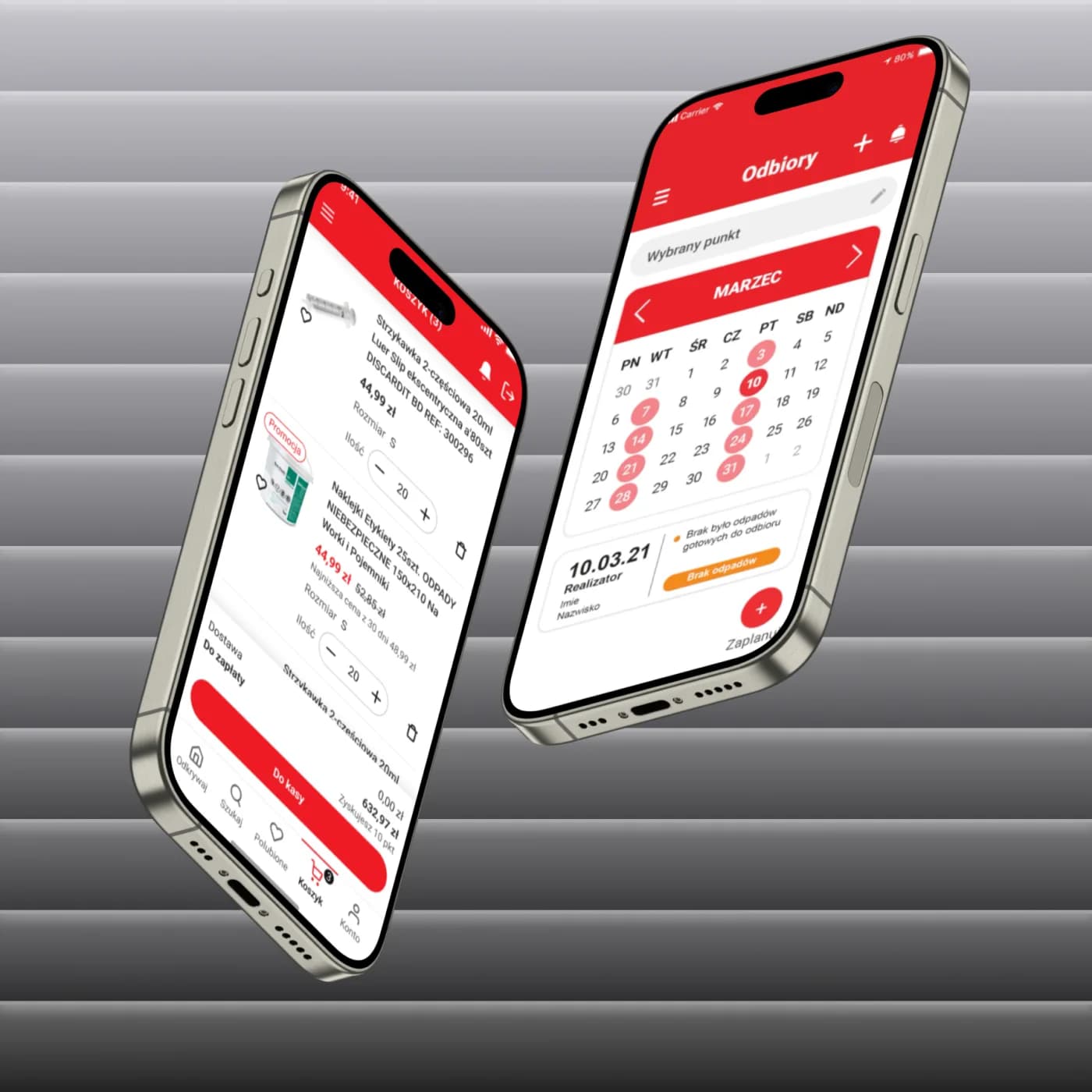
EMKA Mobile
BDO · schedules · payments · customer operations
Reliability is part of the scope
Production integrations need contracts, ownership and an operating model. We design the invisible parts that keep data correct after launch.
Schemas, validation and versioning make changes visible before they break another system.
Queues, idempotency and controlled retries protect against duplicates and temporary outages.
Least-privilege access, secret management and audit trails limit the impact of every connection.
Dashboards, logs and actionable alerts show what failed, why it failed and who owns the response.
Clear scope before implementation
DDT resolves data ownership, edge cases, security and rollout risk before we commit to a fixed-price implementation.
Identify actors, systems, sources of truth, volumes, dependencies and business-critical scenarios.
Define APIs, events, validation, security, error handling and the simplest fitting architecture.
Implement in testable increments with contract tests, realistic data and failure scenarios.
Launch with monitoring, runbooks, ownership and a safe path to recover or roll back.
Choose the right level of integration
We can recommend an off-the-shelf connector, Zapier or Make when custom work would add cost without enough operational value.
Questions to resolve early
Usually yes, but the route depends on available APIs, database access, file exchange and vendor constraints. DDT confirms the safest boundary before implementation.
Critical flows use queues, controlled retries and alerts. The design defines which actions can wait, which must stop and how an operator safely recovers the process.
We use idempotency keys, state checks and auditable event handling. Contract and integration tests cover replay and timeout scenarios before rollout.
Yes. You own the delivered code. We document contracts, dependencies, monitoring and recovery procedures so your team can operate the integration with us or independently.
Yes. We first observe the current flow, logs and failure patterns. Then we prioritize containment, monitoring and the smallest changes that reduce operational risk.
Start with the process, not the connector
Tell us which systems and teams are involved. We will identify the critical handoffs, unknowns and the most practical first step.
Reply within 24h · initial estimate within 48h · fixed price after DDT · full source-code ownership
Have an app idea or need technological support? Write to us — we'll prepare a preliminary analysis and estimate within 48h. Projects that go through our DDT process (Discovery, Design & Technology) come with a price guarantee and a fixed-price agreement — a key differentiator for us.