Technologies·Mobile
React Native - Business Compendium
Technology that shortens time and improves quality
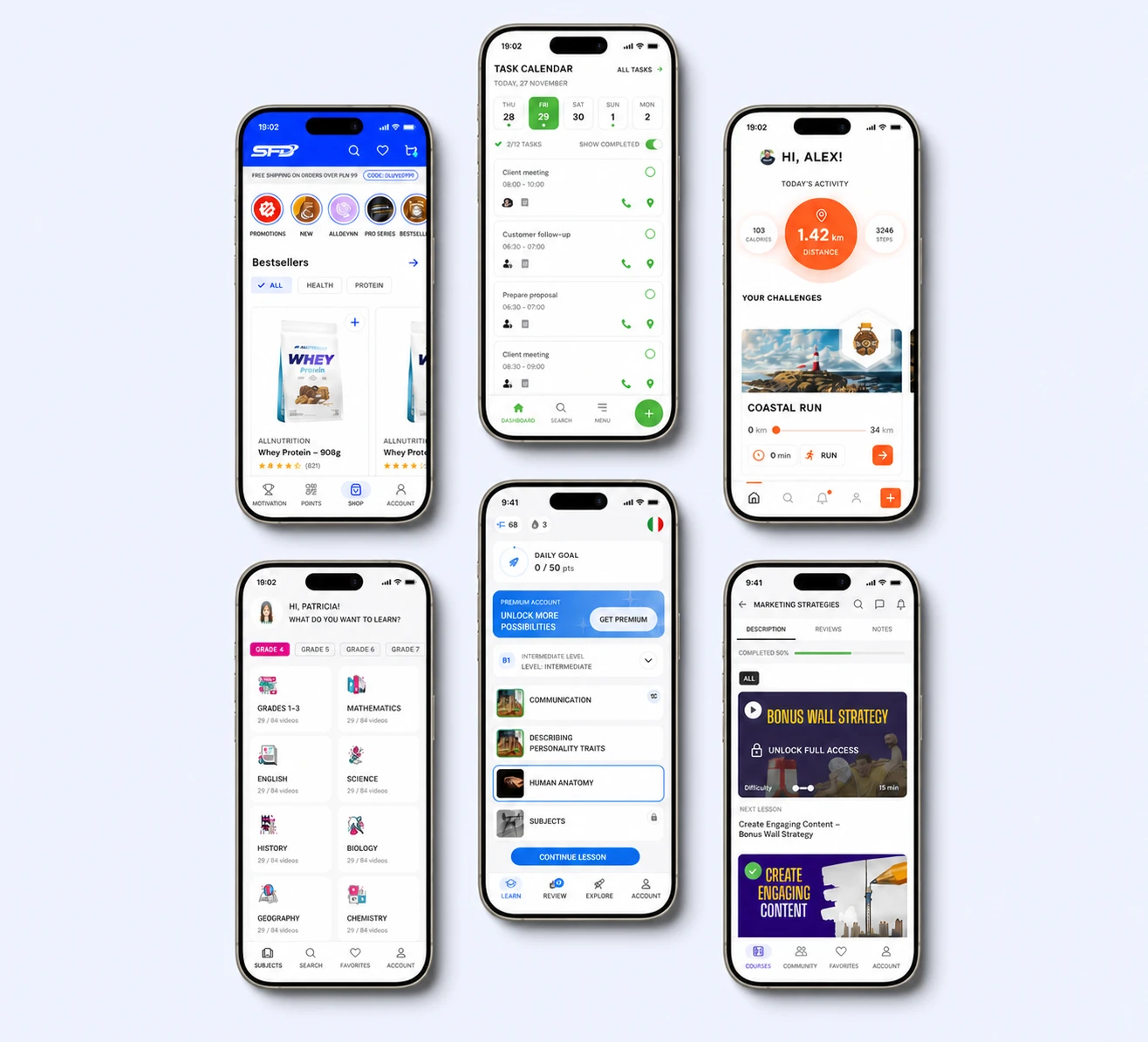
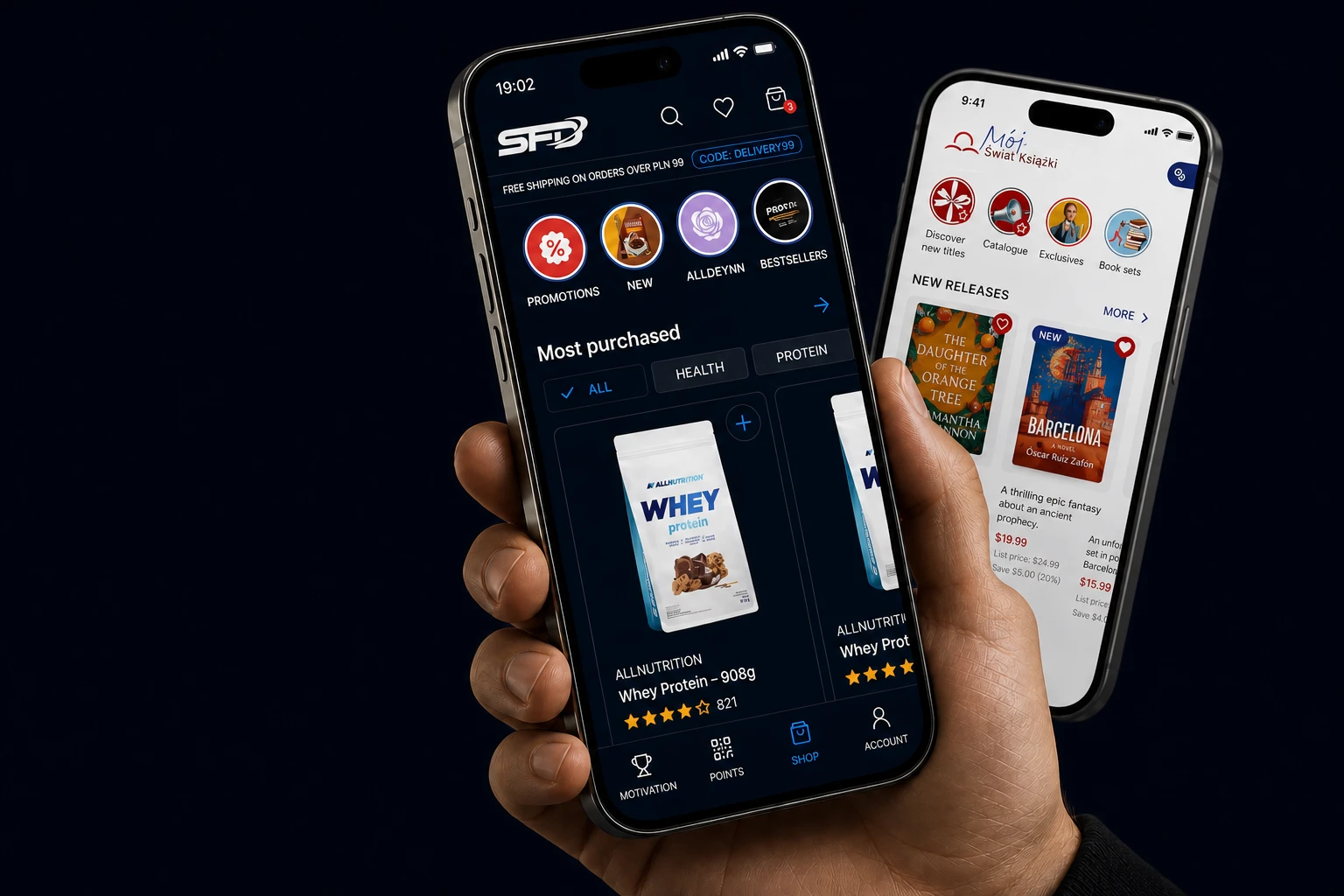
GMI Software is a Gdansk-based agency specializing in React Native and Expo for EU, UK and US companies. The SFD app: 100,000+ downloads, 4.9★ App Store. Initial mobile app estimate within 48 hours.
As a team specializing in React Native, we help match technology to business goals. Below we've gathered practical information to help understand when RN is the best choice.
Last updated: July 2, 2026
Service
Mobile apps for iOS & Android
End-to-end: UX, development, store releases, maintenance — React Native is often the core.
Resources
React Native hub
Dedicated overview, open source, and technical context.
Why US and EU teams hire GMI Software for React Native
Poland nearshore: rates often 30-50% below a typical US agency with Western Europe timezone overlap (CET). English delivery, 2-week sprints and demos every iteration.
- Clutch 4.9★ and 120+ delivered projects
- One partner: mobile + backend + commerce (Medusa)
- Fixed-price guarantee after DDT workshop
- 6+ hours overlap with UK and continental Europe
Last updated: July 2, 2026
How much does a React Native app cost in 2026?
| Scope | Range | Notes |
|---|---|---|
| Loyalty / simple B2C MVP | EUR 18,000 - 28,000 | 3-5 months, iOS + Android |
| Commerce app with integrations | EUR 35,000 - 55,000 | 5-8 months, ERP/payments |
| CRM / field operations mobile | EUR 45,000 - 70,000 | 6-10 months, offline + roles |
| USD reference (MVP) | USD 20,000 - 32,000 | international clients |
Ranges after a DDT scope review. Final cost depends on integrations, offline flows, IoT and compliance. Based on GMI Software delivery data (120+ projects).
React Native vs Flutter vs native - when to pick what?
| Criterion | React Native + Expo | Flutter | Native iOS + Android |
|---|---|---|---|
| MVP time-to-market | 8-14 wks | 10-16 wks | 16-24 wks |
| Cost vs dual native | -30-40% | -25-35% | 100% baseline |
| Native API access | Bridge + Expo modules | Platform channels | Full |
| Web team synergy (React) | High | New Dart stack | Swift + Kotlin |
| GMI default pick | Most B2B/B2C | Existing Flutter team | 3D/AR, gaming |
When is React Native with GMI not the best fit?
Gaming, 3D or AR at native level
For heavy 3D or AR experiences, native stacks or a game engine are often a better fit.
Your team already ships only Flutter/Dart
If hiring and delivery are Flutter-only, switching to RN without a business reason slows delivery.
Very small scope with no growth plan
For a tiny PoC without backend integrations a freelancer may suffice - we focus on production apps.
Related guides
- React Native agency in Europe - how to choose a partner 2026
- Commerce mobile app development guide 2026
- React Native app maintenance cost in 2026
- Expo for business apps - when and why 2026
- React Native app store launch checklist for App Store and Google Play
- React Native vs native apps in 2026: a business decision, not a technology religion
- React Native vs Flutter in 2026 - business decision guide
- React Native app development cost in 2026
When React Native is the best choice
RN works well in projects where priority is fast time-to-market and lower maintenance costs while maintaining high UX quality.
- Loyalty and e-commerce apps requiring rapid iterations
- Sales and CRM apps with complex UX
- Products requiring frequent updates and A/B testing
- B2B apps for internal processes with integrations
- Customer portals and apps with external system integrations
- MVPs and prototypes requiring quick deployment
When to consider alternatives
RN has its limitations - in some scenarios native solutions or other frameworks will be a better choice.
- Apps requiring advanced 3D/AR/VR features
- Gaming apps with high performance requirements
- Projects requiring full control over native APIs
- Apps with very specific platform requirements
- Projects with very long horizon and stable feature scope
Architecture and patterns
In our React Native projects we use proven architectural patterns ensuring scalability and maintainability.
Modular architecture
Division into business modules with clearly defined dependencies. We use Feature-Sliced Design or similar approaches.
State Management
Redux Toolkit or Zustand for global state, React Query for API data caching.
Native integrations
Bridge to iOS/Android modules when needed (payments, biometrics, push notifications).
Type Safety
TypeScript throughout the project + strict mode for predictable code.
Security and quality
Mobile app security requires a comprehensive approach - from code to infrastructure.
Code Review and Static Analysis
Automated code scanning (ESLint, SonarQube) + mandatory code review before merge.
Secure Storage
Keychain (iOS) / Keystore (Android) for sensitive data, encryption at rest.
API Security
HTTPS only, certificate pinning, token-based auth with refresh mechanism.
Testing
Unit tests (Jest), integration tests, E2E (Detox/Appium) for critical flows.
Performance and maintenance
Performance monitoring and proactive maintenance cost management are key to long-term success.
App Performance
Time to Interactive < 3s, FPS > 55, memory usage monitoring, crash rate < 0.1%.
Bundle Size
Bundle size optimization (code splitting, tree shaking), target < 50MB for iOS/Android.
CI/CD
Automated builds, tests and deployment to TestFlight/Play Console. Release cycle: 1-2 weeks.
Maintenance SLA
Bug fixes in 48h (critical) / 1 week (high), security updates within 2 weeks of release.
How we deliver React Native projects
Our delivery process is focused on rapid iterations and transparent communication.
Discovery (1-2 weeks)
Requirements workshops, stack analysis, library selection, proof of concept for key integrations.
Design & Architecture (2-3 weeks)
UX/UI design, module architecture, design system, test plan.
Development (8-16 weeks)
2-week sprints, code review, automated tests, regular demos for stakeholders.
Release & Maintenance
Publication in App Store/Play Store, monitoring, hotfixes, long-term development plan.
Frequently Asked Questions
Is React Native performant enough for production apps?
Yes. RN achieves 90-95% of native app performance with proper architecture. Key is avoiding unnecessary re-renders, image optimization and using native modules for critical operations.
How long does migration from native app to React Native take?
Depends on complexity. Simple app: 3-6 months. Complex with many integrations: 6-12 months. We recommend incremental approach - module by module migration.
Can we use existing native libraries in React Native?
Yes, through bridge. Most popular libraries already have ready wrappers (e.g. Stripe, Firebase). For custom solutions we create our own bridges.
Related Case Studies
Want to use this technology in your project?
Contact us to discuss how we can help with your project.
Let's talk
about the project.
Have an app idea or need technological support? Write to us — we'll prepare a preliminary analysis and estimate within 48h. Projects that go through our DDT process (Discovery, Design & Technology) come with a price guarantee and a fixed-price agreement — a key differentiator for us.
80-890 Gdansk, Poland