gmi.software
01 · Your app

Mobile apps

When the app is slow to change, crashes or nobody owns it.

  • Develop or take over an app
  • Loyalty apps
  • Mobile app code audit
  • App maintenance and releases

SFD: 100,000+ downloads, 4.9 App Store rating

02 · Your shop

Online shops

When the platform takes a cut of every sale or blocks what you need.

  • Online shop development
  • Shop app analytics
  • Plan and prototype before you build

120+ projects delivered

03 · Systems behind them

Integrations

When orders, stock and points are copied by hand.

  • ERP, warehouse and payments
  • AI for one manual process
  • Workshops and estimate

100+ integrations

Before a call
  • App cost estimateScope and a budget range
  • Shop platform adviserDecisions, risks and options
  • Shop cost over 5 yearsOff-the-shelf or custom, compared

After workshops: an agreed scope and a fixed price for delivering it

All services →
SFDLoyalty and shopping app100,000+ downloads · 4.9 App Store ratingMój Świat KsiążkiLoyalty programme for a bookstore chain100,000+ downloadsEMKAMedical waste tracking app5000+ downloads in first month
All 120+ projects →App ideas library
TeamAbout usWho we are and how we workCareersHow we work and open roles
Contact and stackContact[email protected]TechnologiesReact Native, MedusaJS, Node.js and the rest
Reviews5.0 on Google4.9 on ClutchClutch ↗ (opens in a new tab)
Blog
ENBook a free consultation
What we do+−

01 · Your app

Mobile apps

  • Develop or take over an app
  • Loyalty apps
  • Mobile app code audit
  • App maintenance and releases

02 · Your shop

Online shops

  • Online shop development
  • Shop app analytics
  • Plan and prototype before you build

03 · Systems behind them

Integrations

  • ERP, warehouse and payments
  • AI for one manual process
  • Workshops and estimate

Before a call

  • App cost estimateScope and a budget range
  • Shop platform adviserDecisions, risks and options
  • Shop cost over 5 yearsOff-the-shelf or custom, compared
All services →
Projects+−
  • SFD100,000+ downloads · 4.9 App Store rating
  • Mój Świat Książki100,000+ downloads
  • EMKA5000+ downloads in first month
  • All 120+ projects →
  • App ideas library
Company+−
  • About usWho we are and how we work
  • CareersHow we work and open roles
  • Contact[email protected]
  • TechnologiesReact Native, MedusaJS, Node.js and the rest
Blog→
Book a free consultation

5.0 on Google · 4.9 on Clutch

•B2B marketplace

Multi-vendor marketplace for B2B trade

When one cart connects many suppliers and one enterprise buyer

A B2B multi-vendor marketplace connects many suppliers to enterprise buyers in one cart—with split checkout, roles and limits; it almost always needs a custom backend (MACH, NestJS, queues), not a storefront template alone.
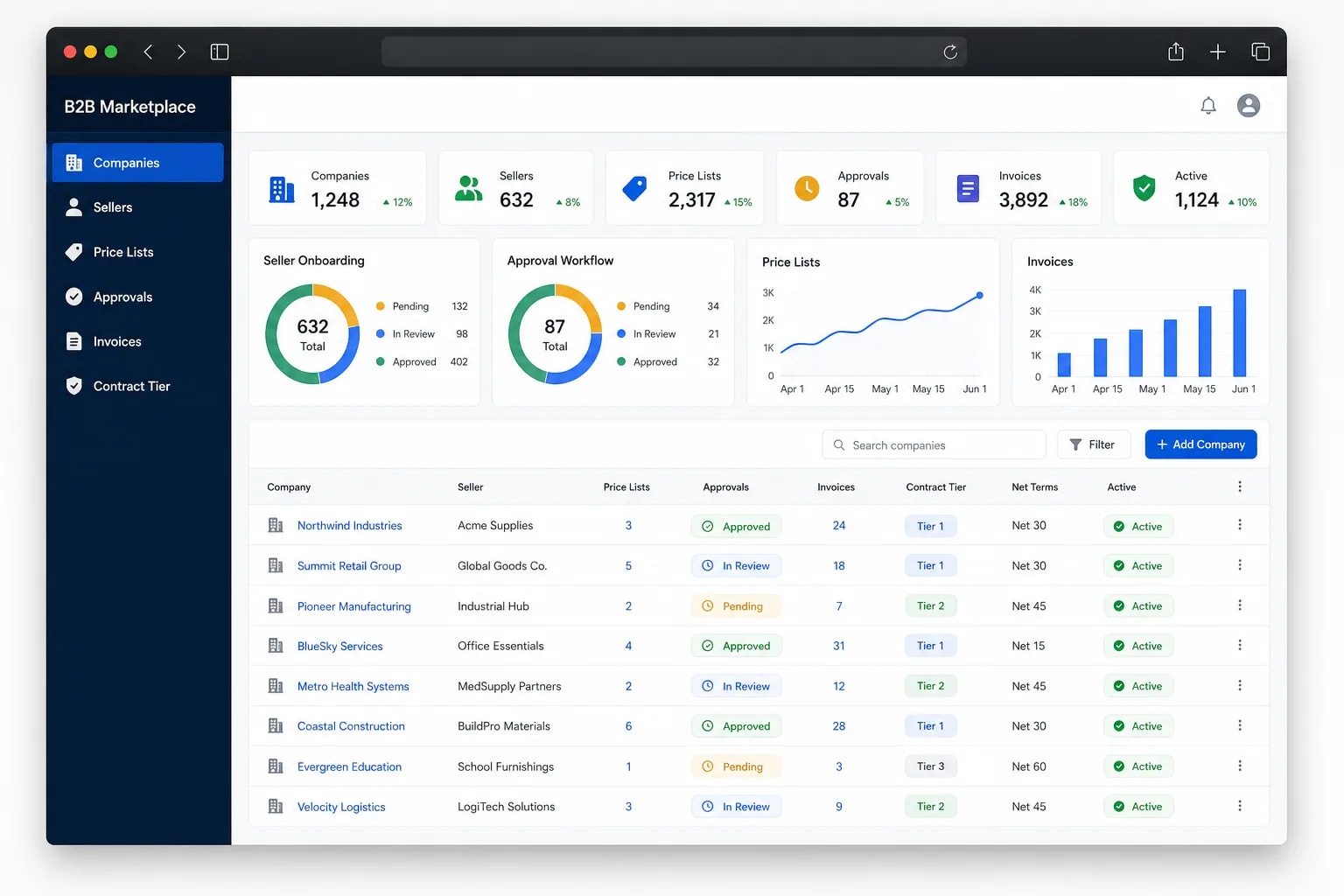
This is one of the hardest commerce shapes: you do not only sell your own catalogue — you orchestrate transactions between vendors and buying organizations. That requires account hierarchies (requesters, approvals, finance), contract- and volume-aware pricing, cart splits per supplier, different fulfilment SLAs, and platform fees and settlements. Credit insurance or trade limits are common. Templates rarely survive — we design domain services, API-first contracts and event flows (e.g. NestJS + PostgreSQL + queues), and connect the commerce layer with MedusaJS or a bespoke engine when the model exceeds standard catalogues.
Get in touch with us>See process
Advanced commerce system: a large operations screen with catalog, orders, ERP, WMS, PIM integrations, and sales workflows.

Platform

From many suppliers to one customer order

Complexity sits in rules and data consistency — the UI is a thin layer over events and APIs.

Many SKUs, one checkout

Customers see a single flow; behind the scenes the order splits into fulfilments, stock moves and invoices per vendor.

Rules in domain code

Permissions, limits and contracts enforced in backend services — not in a cart template.

Settlement & fees

Split payment mechanics and platform reporting without manual spreadsheet reconciliation.

Traffic & peaks

Queues, retries and monitoring — readiness for concurrent B2B orders across vendors.

Spec→Build→Ship

Cooperation process

How does our cooperation look like?

A transparent process that leads from idea to finished product

  1. 01

    Model & responsibility boundaries

    We map parties (platform, vendors, buyers), order lifecycle, settlements and compliance. We define a credible MVP.

  2. 02

    Organizations & permissions

    We design org trees, roles, purchase limits, approval paths and audit trails — the B2B foundation.

  3. 03

    Cart, split & fulfilment

    We split orders per vendor, shipping costs, stock and SLAs. We define partial fulfilment and cancellation rules.

  4. 04

    Payments & settlement

    Split payouts, platform fees, deferred payments, exports to ERP/finance. Gateways and credit partners as required.

  5. 05

    Scale & observability

    Queues, idempotency, monitoring and load tests for “many vendors at once” scenarios.

Key benefits

Why choose us?

Business outcomes first—technology is the means, not the end in itself.

01

Org hierarchies

Many people and departments under one customer account — permissions under control.

02

Pricing & contracts

Commercial terms live in the system, not only in spreadsheets.

03

Split checkout

One customer order, many fulfilments and settlements for suppliers.

04

Security & audit

Traceability: who ordered, who approved, who sees which prices.

Questions about this system type

Why is a B2B marketplace rarely “just a shop template”?
Because beyond a catalogue you need org hierarchies, permissions, cart splits and settlements across suppliers—and often credit workflows. That is domain logic and events, not a theme.
Do you integrate trade credit or receivables insurance?
Yes—as a common integration area. We connect finance partners and limit workflows to match your model, with idempotent APIs and audit trails.
What tech usually backs such an engine?
Often NestJS domain services, PostgreSQL, queues (Redis/RabbitMQ/SQS), Next.js storefronts; the commerce layer may be MedusaJS or bespoke when orders exceed standard catalogue assumptions.

Content last updated: March 18, 2026

Technologies

What technologies do we use?

Modern tools and proven solutions for the best results

01
Next.js
Frontend
02
MedusaJS
Commerce core
03
NestJS
Backend
04
TypeScript
Language
05
PostgreSQL
Database
06
REST / events
Integracje
07
Redis
Cache / kolejki
08
RabbitMQ / SQS
Messaging

Related

Headless & B2B commerce

Broader view of storefronts, MedusaJS and ERP/PIM integrations.

>
Client testimonials

They trusted us and see results.

EMKA S.A.

Sławomir Rdest

Board Advisor, EMKA S.A.

“As long-term clients of GMI Software, we had the pleasure of working with them for several years. GMI Software stood out during the tender process with a refreshing, positive approach and the professionalism of the CEO and team.”
More case studies:Case studies
Service scope

What does the service include?

Below is an example scope of work that we adjust to the stage and goals of the project.

01Many sellers × institutional buyers
02Roles, limits, approvals and purchasing policies
03Dynamic pricing from contracts, currencies and tiers
04Split payments and platform commission
05ERP / finance / credit-insurance integrations
06Next.js storefronts or B2B portals on the same backend

Next step

Ready to start?

Schedule a free consultation and learn how we can help with your project. After our DDT process (Discovery, Design & Technology), we offer a price guarantee and a fixed-price agreement.

Schedule consultation>Start brief assistant

Let’s discuss your project.

Tell us what you need. We’ll suggest the next step.

[email protected]
gmi.software Sp. z o.o.ul. Jana Heweliusza 11 / 819
80-890 Gdansk, Poland
Rated 5.0 out of 5 on Google5.017 client reviews on Google
TechnologiesReact NativeExpoNext.jsReactTypeScriptMedusaJS3D configuratorsNode.jsNestJSPostgreSQLDockerAWSPlaywrightMaestro
© 2026 gmi.software Sp. z o.o.
Privacy PolicyTerms