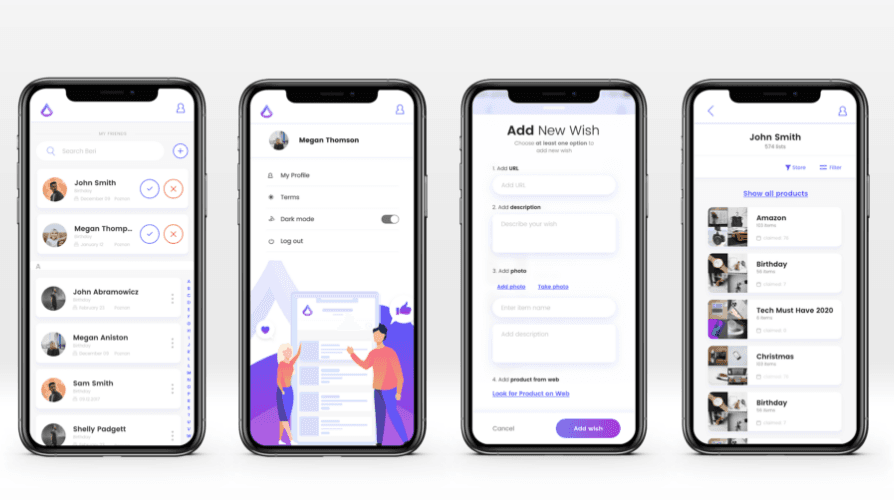
Beri Gifts: a mobile wishlist app built without an official data API
From a two-week proof of concept to an MVP released on iOS and Android. The project shows how to validate a risky integration before investing in the full product.
The idea: one gift list across multiple stores
Beri Gifts wanted a mobile app where people could build gift lists from products found across different online stores. The key scenario involved importing an Amazon wishlist, but the official API did not expose the data the product needed.
Instead of starting with the full build, GMI ran a Product Design Workshop. The team structured the business model, technical requirements and user journey, then isolated the largest technical uncertainty as a separate experiment.
A proof of concept before the full investment
Two developers spent a two-week sprint testing an Amazon scraper and the friend-invitation flow. The goal was not production code. It was to answer one decision question: could the data be collected reliably enough to justify an MVP?
The PoC succeeded. Only then did the team extend the concept beyond services with ready-made wishlists and design an in-app browser that could add products from different websites.
- Validate the technical constraint before committing the MVP budget.
- Separate integration risk from the rest of the product.
- Use workshops and mockups to agree the product flow.
Five sprints with the client as Product Owner
The MVP was planned as five weekly sprints. Two full-stack developers, a Customer Success Manager and a designer worked with the client, who joined planning, reviews and retrospectives so product decisions did not wait for another approval layer.
GMI also delivered the UX/UI and a simple product landing page. The app was completed on schedule and tested with a small user group before release.
The release required defending the product logic
Google Play accepted the app immediately, while Apple challenged its use of data originating from other platforms. Instead of rewriting half of the product, the team documented the logic and worked through the review process.
The app was ultimately released in both stores. The central lesson was to treat third-party platform constraints as a product and policy risk, not only as an engineering task.
Related GMI services
See how we build similar products for international clients.
Let's talk
about the project.
Have an app idea or need technological support? Write to us — we'll prepare a preliminary analysis and estimate within 48h. Projects that go through our DDT process (Discovery, Design & Technology) come with a price guarantee and a fixed-price agreement — a key differentiator for us.
80-890 Gdansk, PolandNearshore product delivery across EU, UK and US time zones.